

Sale prijs € 2,67.
Originele prijs € 3,55 per kaart
Je bespaart 25%
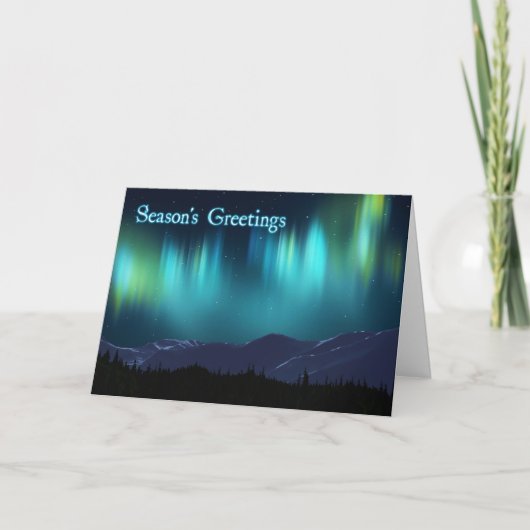
Seizoensgroeten - Noorderlicht Feestdagen Kaart
Bekijk productdetailsOver Dubbele feestdagenkaarten
Aangeboden door
Over dit ontwerp
Seizoensgroeten - Noorderlicht Feestdagen Kaart
A multi-colored, fractal rendering of the aurora borealis, or Northern Lights, superimposed on a digital painting of snow-covered mountains. Text reading "Season's Greetings" also appears in glowing blue and white. The aurora borealis (or Northern Lights), named after the Roman goddess of dawn, Aurora, and the Greek name for the north wind, Boreas. Many cultural groups have legends about the lights. In medieval times, the occurrences of auroral displays were seen as harbingers of war or famine. The Maori of New Zealand shared a belief with many northern people of Europe and North America that the lights were reflections from torches or campfires. The Menominee Indians of Wisconsin believed that the lights indicated the location of manabai'wok (giants) who were the spirits of great hunters and fishermen. The Inuit of Alaska believed that the lights were the spirits of the animals they hunted: the seals, salmon, deer and beluga whales. Other aboriginal peoples believed that the lights were the spirits of their people. The connection between the Northern Lights and sunspot activity was suspected as far back as 1880. Thanks to research conducted since the 1950's, we now know that electrons and protons from the sun are blown towards the earth on the 'solar wind'. (Note: 1957-58 was International Geophysical Year and the atmosphere was studied extensively with balloons, radar, rockets and satellites. Rocket research is still conducted by scientists at Poker Flats, a facility under the direction of the University of Alaska at Fairbanks. The temperature of the sun's atmosphere is millions of degrees. At this temperature, collisions between gas molecules are frequent and explosive. Free electrons and protons are thrown from the sun's atmosphere by the rotation of the sun and escape through holes in the magnetic field. carried eartward in the solar wind, the charged particles are largely deflected by the earth's magnetic field. However, the earth's magnetic field is weaker at either pole and therefore some particles enter the earth's atmosphere and collide with gas particles in the higher layers (thermosphere). These collisions emit light that we perceive as the dancing lights of the north (and the south). Most aurorae occur in a band known as the auroral zone,which is typically 3° to 6° in latitudinal extent and at all local times or longitudes. The auroral zone is typically 10° to 20° from the magnetic pole defined by the axis of the Earth's magnetic dipole. During a geomagnetic storm, the auroral zone will expand to lower latitudes. The diffuse aurora is a featureless glow in the sky which may not be visible to the unaided eye even on a dark night and defines the extent of the auroral zone. The discrete aurora are sharply defined features within the diffuse aurora which vary in brightness from just barely visible to the unaided eye to bright enough to read a newspaper at night. Discrete aurorae are usually observed only in the night sky because they are as bright as the sunlit sky. Aurorae occasionally occur poleward of the auroral zone as diffuse patches or arcs (polar cap arcs, which are generally invisible to the unaided eye. Because the phenomena occurs near the magnetic poles, northern lights have been seen as far south as New Orleans in the western hemisphere, while similar locations in the east never experience the mysterious lights. However the best places to watch the lights (in North America) are in the northwestern parts of Canada, particularly the Yukon, Nunavut, Northwest Territories and Alaska. Auroral displays can also be seen over the southern tip of Greenland and Iceland, the northern coast of Norway and over the coastal waters north of Siberia. Southern auroras are not often seen as they are concentrated in a ring around Antarctica and the southern Indian Ocean. Auroral displays appear in many colors. Variations in color are due to the type of gas particles that are colliding. The most common auroral color, a pale yellowish-green, is produced by oxygen molecules located about 60 miles above the earth. Rare, all-red auroras are produced by high-altitude oxygen, at heights of up to 200 miles. Nitrogen produces blue or purplish-red aurora. The lights appear in many forms from patches or scattered clouds of light to streamers, arcs, rippling curtains or shooting rays that light up the sky with an eerie glow. Curtain-like structures show field lines in the Earth's magnetic field . The auroras that resulted from the "great geomagnetic storm" on both 28 August and 2 September 1859 are thought the most spectacular in recent recorded history. It was reported by the New York Times that in Boston on Friday 2 September 1859 the aurora was "so brilliant that at about one o'clock ordinary print could be read by the light". The aurora is thought to have been produced by one of the most intense coronal mass ejections in history, very near the maximum intensity that the Sun is thought to be capable of producing. It is also notable for the fact that it is the first time where the phenomena of auroral activity and electricity were unambiguously linked. This insight was made possible not only due to scientific magnetometer measurements of the era, but also as a result of a significant portion of the 125,000 miles (201,000 km) of telegraph lines then in service being significantly disrupted for many hours throughout the storm. Some telegraph lines, however, seem to have been of the appropriate length and orientation to produce a sufficient geomagnetically induced current from the electromagnetic field to allow for continued communication with the telegraph operator power supplies switched off. Both Jupiter and Saturn have magnetic fields much stronger than Earth's (Jupiter's equatorial field strength is 4.3 gauss, compared to 0.3 gauss for Earth), and both have large radiation belts. Auroras have been observed on both, most clearly with the Hubble Space Telescope. Uranus and Neptune have also been observed to have auroras.
Ontwerp van international designer

Klant beoordelingen
3.3 van 5 sterren beoordeling7 aantal beoordelingen
7 Reviews
Beoordelingen voor identieke producten
5 van 5 sterren beoordeling
Door Anoniem14 december 2025 • Geverifieerde aankoop
Dubbele feestdagenkaart, maat: Standaard, 12,7 x 17,8 cm, papier: Signature Mat
Altijd leuke kaarten. Heel persoonlijk en van erg goede kwaliteit.
5 van 5 sterren beoordeling
Door Karin L.22 oktober 2023 • Geverifieerde aankoop
Dubbele feestdagenkaart, maat: Standaard, 12,7 x 17,8 cm, papier: Signature Mat
Zazzler recensent programma
Mooie kaart en stevig. Prima kleur gevonden op internet
5 van 5 sterren beoordeling
Door R.25 december 2012 • Geverifieerde aankoop
Dubbele feestdagenkaart, maat: Standaard, 12,7 x 17,8 cm, papier: Signature Mat
Zazzler recensent programma
Een kaart van zware kwaliteit papier. Mooi om te geven, absoluut de moeite waard om te krijgen. Het beeld op de computer doet de kaart geen recht aan. In het echt komen de kleuren nog mooier uit en is de afbeelding nog mooier.
Tags
Andere Info
Product ID: 137864903852339106
Ontworpen op: 27-9-2014 20:39
Rating: G
Recent bekeken items