
Over Dubbele wenskaarten
Aangeboden door
Over dit ontwerp
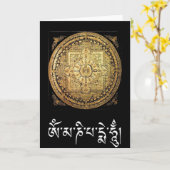
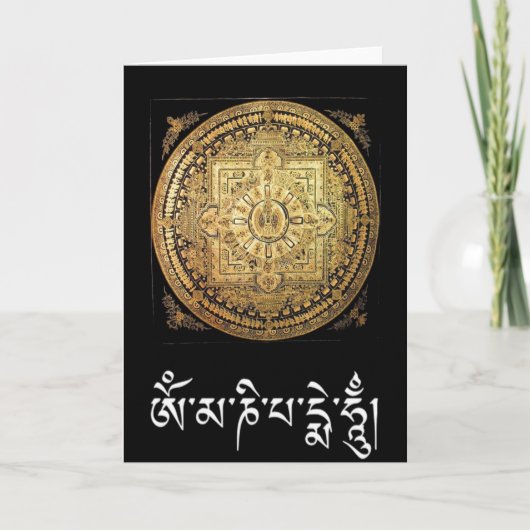
Thousand-Armed Avalokiteshvara Mandala Greet. Card Kaart
About Mandalas
Mandala is a Sanskrit word that means "circle". In the Buddhist and Hindu religious traditions their sacred art often takes a mandala form. The basic form of most Hindu and Buddhist mandalas is a square with four gates containing a circle with a center point. Each gate is in the shape of a T.
These mandalas, concentric diagrams, have spiritual and ritual significance in both Buddhism and Hinduism. The term is of Hindu origin, but is also used in Buddhism. In the Tibetan branch of Vajrayana Buddhism, mandalas have been developed into sandpainting.
In various spiritual traditions, mandalas may be employed for focusing attention of aspirants and adepts, as a spiritual teaching tool, for establishing a sacred space, and as an aid to meditation and trance induction. Its symbolic nature can help one to access progressively deeper levels of the unconscious, ultimately assisting the meditator to experience a mystical sense of oneness with the ultimate unity from which the cosmos in all its manifold forms arises The psychoanalyst Carl-Gustav Jung saw the mandala as "a representation of the unconscious self" .
In common use, mandala has become a generic term for any plan, chart or geometric pattern that represents the cosmos metaphysically or symbolically, a microcosm of the Universe from the human perspective.
Avalokiteshvara
is a bodhisattva who embodies the compassion of all Buddhas. He is one of the more widely revered bodhisattvas in mainstream Mahayana Buddhism. He is also known as Chenrezig (Tibetan), Kuan-Yin / Guanyin (Chinese), Lokeshvara (Sanskrit) and Kannon (Japanese).
A total of 33 different manifestations of Avalokitasvara are described in Buddhist literature, including female manifestations, all to suit the minds of various beings.
Seven forms of Avalokiteśvara are known in Tibetan Buddhism:
1. Amoghapāśa: not empty (or unerring) net, or lasso.
2. Vara-sahasrabhuja-locana / Sahasrabhujasahasranetra: 1000-hand and 1000-eye,
3. Hayagriva: with the head of a horse
4. Ekadasamukha: with 11 faces
5. Cundī
6. Cintamani-cakra: wheel of sovereign power
7. Arya Lokiteśvara: the Holy sovereign beholder of the world (loka)
Thousand-armed Avalokiteshvara
One prominent Buddhist story tells of Avalokiteśvara vowing never to rest until he had freed all sentient beings from samsara, and to postpone his own Buddhahood until he has assisted every being on Earth in achieving Nirvana. Despite strenuous effort, he realizes that still many unhappy beings were yet to be saved. After struggling to comprehend the needs of so many, his head splits into eleven pieces. Amithaba Buddha, seeing his plight, gives him eleven heads with which to hear the cries of the suffering. Upon hearing these cries and comprehending them, Avalokiteśvara attempts to reach out to all those who needed aid, but found that his two arms shattered into pieces. Once more, Amitabha Buddha comes to his aid and invests him with a thousand arms with which to aid the suffering multitudes.
Mantra
Mahāyāna Buddhism relates Avalokiteśvara to the six-syllable mantra om mani padme hum. Due to his association with this mantra, in Tibetan Buddhism Avalokiteśvara is also called Shadakshari, which means "Lord of the Six Syllables." Recitation of this mantra along with prayer beads, is the most popular religious practice in Tibetan Buddhism.

Klant beoordelingen
4.6 van 5 sterren beoordeling23 aantal beoordelingen
23 Reviews
Beoordelingen voor identieke producten
5.0 van 5 sterren beoordeling
5 van 5 sterren beoordelingDoor M H.1 januari 2024 • Geverifieerde aankoop
Dubbele wenskaart, maat: 12,7 × 17,8 cm, papier: Signature Mat
Zazzler recensent programma
Zoals reeds eerdere bestellingen weer super service en correcte levering. Perfect zoals het voorbeeld dat je kunt aanschouwen. Absoluut geen verschil
5.0 van 5 sterren beoordeling
5 van 5 sterren beoordelingDoor Annelies M.20 oktober 2025 • Geverifieerde aankoop
Dubbele wenskaart, maat: 12,7 × 17,8 cm, papier: Signature Mat
Kaart precies zoals gehoopt en vlot geleverd.
5.0 van 5 sterren beoordeling
5 van 5 sterren beoordelingDoor C K.6 juni 2018 • Geverifieerde aankoop
Dubbele wenskaart, maat: 12,7 × 17,8 cm, papier: Signature Mat
Zazzler recensent programma
Goede kwaliteit en een orginele kaart! Duidelijke afdruk van de toegevoegde foto’s
Tags
Andere Info
Product ID: 137602236635844153
Ontworpen op: 22-11-2011 4:28
Rating: G