Over Briefkaarten
Aangeboden door
Over dit ontwerp
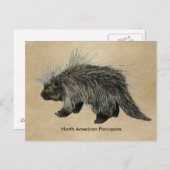
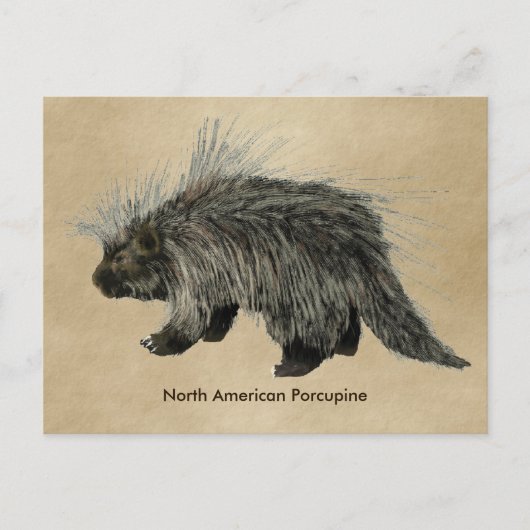
Porcupine op oud papier briefkaart
A digital painting of a porcupine and customizable text reading "North American Porcupine" superimposed on an old paper background image. n Porcupines are indigenous to the Americas, southern Asia, and Africa. Porcupines are the third largest of the rotanden, behind the capybara and the beaver. Most porcupines are about 25-36 in (63-91 cm) long, met een lengte van 8-10 in (20-25 cm). Weighing between 12-35 lb (5,4-16 kg), they are rounded, large and slow. Porcupines als in various shades of brown, grey, and the unusual white. Porcupines' spiny protection resembles that of the unrelated hedgehogs and echidnas. The name porcupine comes from Middle French ACP espin (spined pig) A regional American name for the animal is quill pig. The North American porcupine, Erethizon dorsatum, has the northernmost range of all the world's porcupines. Evidence indicates that they have only been a part of North American fauna oprillion they immigrated north from South America some three million years ago. Porcupines are 25 to 31 inches long covered with hair and quills of varying length, behalve on the foot pads and nose. The tips of the long guard hairs are lighter and give the coat hues of yellow or white. The hair and a thick layer of body fat helps keep the porcupine warme during the winter. The tail is extremely muscular and adapted to aid in klimbing and defense. The upper oppervlakte of the tail is heavily covered with quills, while the underside is covered in bristle-like hairs used to aid in klimaat. The quilled pelage of the porcupine makes is de enige among North American mammals. Quills cover the body, behalve in the legs and belly. The quills are modified hairs which have microscopic barbs on the tips and are filled with a spongy matrix. Quills from different parts of the body vary in length, flexibility, color, shaft diameter, and barb length. The average weight of an adult male porcupine ranges from 15 to 18 pounds, but some individuals can weigh up to 30 pounds. Adult femes weigh about 2-4 inch than males. Porcupine have senses of smell, hearing, and taste, but relatively poor eyesight. Porcupines make a wide variety of sounds ranging from whimpers to screams, depending upon the circumstance. Breeding takes place in the fall months from late September to early November Males seeking receptifemales expand their home ranges up to five times the standard size. If more than one male shows interest in the same female, they will fight for the opportunity to mate with the female. Males use their incisor teeth and quills when fighting, and usually it is the largest and heaviest male which wins dominance. The breeding male then splashes the female with urine. If she is not ready to mate, shakes off the urine and leaves. If she is ready, she stays and the male mounts in the traditional posture with the female in front and the male in the rear. She will curl her over her back, covering most of the quills. Males reach maturity at 24 months and females at 12 months. After a gestation period of about 210 days, only a single young is born. The gestation period is extremely long for a rodent, twice the time for a beaver. At birth the young weighs between 1 and 2 pounds and is about 10 lange inches. Its eyes are open and its body covered with long grayish-black hairs and quills. Within a matter of hours the quills dry and serve as protection. The young porcupine is then capade of following its mother, although the young will not be able to klimb large trees for several weeks. The young are able to eat some vegetation after a few weeks, but the female continuation the young for 3.5 months. During the summer the young stay close to their mothers, learning about den sites and food trees, but toward the end of summer they start to spend more time apartment. By October, when the female mates again, the young are fully weaned and wander off to face the winter alone. Porcupines utilize natural cavities, such as rock caves, hollow logs and trees, or even the thicker vegetation in a tree as dens. In areas without snowfall, tuinen are not used so much. Porcupines stay active throughout the winter. Porcupines are primarily arboreal, and spend most of their time in the winter feeding in trees. While powerful klimaat, porcupines do occasionally fall from trees. Thirty procent of the animals examined in one study showed evidence of healed fractures indicating that they had fallen out of trees. When klimbing, the porcupine uses the stiff bristles on the underoppervlak of the tail as support. Het langlevende dier, curved front claws which also aid in klimaat. The inner bark of spruce, birch and hemlock and spruce needles are the major winter foods for porcupine living in Alaska. In the spring and summer, buds and young green leaves of birch, aspen, cottonwood and willow are eaten until the tannin levels build too high for the porcupine to tolerate. Because they are vegetarians and most vegetable matter is very low in natrium, porcupines need additional natrium in the blood to balance cell kalium levels. As a result, porcupines seek out salt source such as natural licks, glue which bonds plywood together, human perspiration on tools, road salt, and some paints. Porcupines also feed on shed antlers and the bones of dead animals to obtain natrium and calcium. Most carnivoren would not pass up a meal of porcupine. However, an encounter between a young inexperienced predator and a porcupine can be a very painful experience. Some unfortunate carnivores have starved to death beerce a mouthful of quills has prevented them from eating. In an inspanning to remove the quills, the predator can is the barbed quills to work into the deep tissues. Predators have different means of killing and eating porcupines. In the Northeast United States, the fisher has learned to specialize on a diet of porcupine. The fisher circles around the porcupine until it can bite its nose. After repeated bites to the nose, the fisher then flips the porcupine over to attack the quill-free belly. The porcupine is then eaten leaving an empty quill-covered skin. This method may also be practiced by lynx, wolves, coyotes, and wolverines which have been recorded eating porcupines in Alaska. When the porcupine is relaxed, the hair and quills bindt flat and point backwards. When threatened, the porcupine draws up the skin of the back to expose quills facing all directions, and it then presents its fantasable bristling back. The porcupine tries to keep its back facing the attacker and strikes back and forth with its tail. Contrary to popular belief, a porcupine can not throw its quills. However, quills are readily dislodged on impact which may give the pression that quills can be thrown. The porcupine can be easily approached and killed with a club bevention of its plodding gait. This Streepje has essa the lives of hungry Natives, trappers, and miners in times past. Some people find the meat too strong, but in some areas of the state, porcupines with their heavy layer of fat are considered a delicacy. Quills sewn onto deerskin used to be the trading wampum of the Northeastern Indian tribes. Quills are still used for decoration by the AthabasBalkan of Interior Alaska. Natives used to kill porcupines just for their quills, but today Alaska Natives corner the animal and then tap the back of the animal with a styrofoam paddle to collect all the quills they need. The quills are dyed with locally obtainable vegetable materials and then sewn into skin clothing, earrings, and artistic items. Porcupines can be invulous to commercial forests and reforestation projects by feeding on the terminal buds or eating the bark all the way around the trees. When such problems occur, site specific control may be necessary, although within most of Alaska porcupines are not numerous enough to do much damage.
Ontwerp van international designer

Klant beoordelingen
4.5 van 5 sterren beoordeling28 aantal beoordelingen
28 Reviews
Beoordelingen voor identieke producten
3 van 5 sterren beoordeling
Door Anoniem13 juli 2024 • Geverifieerde aankoop
Briefkaart, Maat: Standaard Briefkaart, Papier: Signature Mat, Enveloppen: Geen
It's a nice picture, however it doesn't touch the edges of the card. Plus, the cut after print is done poorly. It's printed nicely, but the finish isn't good
5 van 5 sterren beoordeling
Door M.18 mei 2022 • Geverifieerde aankoop
Briefkaart, Maat: Standaard Briefkaart, Papier: Signature Mat, Enveloppen: Geen
Zazzler recensent programma
It is beautiful! Now I want to visit this museum. Perfect. Love the texture of the paper.
4 van 5 sterren beoordeling
Door Anoniem13 juli 2024 • Geverifieerde aankoop
Briefkaart, Maat: Standaard Briefkaart, Papier: Signature Mat, Enveloppen: Geen
Again, edges poorly cut. Print OK, badly cut edges
Tags
Andere Info
Product ID: 239356599979273219
Ontworpen op: 12-10-2017 9:29
Rating: G
Recent bekeken items